

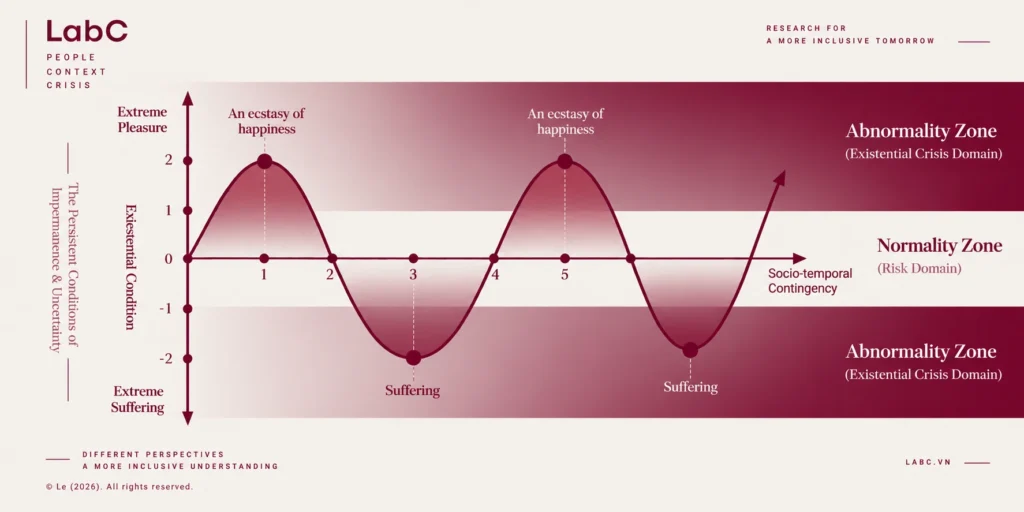
Dr. phil. Ngoc-Son Le has published a new article in Crisis and Risk Communication (Taylor & Francis) proposing a de-Westernized inclusive typological theory of crisis and reconsidering how crisis is conceptualized, classified, and understood.
The article begins with a fundamental question: What is a crisis, ontologically?
Conventional crisis theories have largely been built around an equilibrium-centered assumption in which stability represents the normal condition and crisis constitutes a disruption or deviation from it. The article challenges this assumption by proposing an alternative ontology grounded in uncertainty and impermanence, drawing in particular on Buddhist philosophical insights. Within this perspective, normality is understood as a dynamic equilibrium, rather than a fixed or permanent state.
Building on this ontological shift, the study develops an inclusive typological theory of crisis combining three analytical dimensions: the Normality–Abnormality continuum, the Complexity–Stakeholder matrix, and a seven-type multilevel classification. The framework encompasses individual, organizational, and societal crises, while also identifying hybrid configurations that emerge through interactions across these levels. At its most complex level, it introduces the concept of Mega Hybrid Crisis, providing a conceptual mechanism for understanding the interconnected and mutually constitutive character of contemporary polycrises.
The article makes several broader theoretical contributions. First, it reconceptualizes crisis ontologically, shifting attention from crisis as an exceptional event toward crisis as a phenomenon emerging from the conditions of uncertainty and impermanence inherent in human and social existence. Second, it proposes a multilevel and integrative analytical space in which individual, organizational, and societal crises can be examined together rather than treated as isolated categories. Third, it provides a conceptual basis for understanding how crises intersect, interact, and transform across levels, offering an alternative way of approaching the evolution of polycrisis.
A further contribution is the argument that context is constitutive of crisis rather than merely contextual. Cultural, social, political, and institutional conditions do not simply surround a crisis; they participate in shaping what constitutes, defines, and differentiates a crisis. The framework therefore places greater emphasis on human experience and context-dependent meaning in crisis conceptualization.
The study also contributes to the de-Westernization of crisis communication theory. Rather than rejecting established Western theories, it questions the extent to which their underlying ontological assumptions can be treated as universally applicable. By drawing on alternative epistemological and philosophical resources, including Buddhist perspectives, the article seeks to broaden the ontological and epistemic foundations of crisis research.
Beyond its theoretical implications, the framework offers a context-sensitive analytical and diagnostic tool for crisis research and management. By locating a crisis along the Normality–Abnormality continuum and across different levels of complexity and stakeholder involvement, it provides a structured way to examine the nature and dynamics of different crisis configurations. The article also discusses implications for resilience, suggesting that understanding crisis as a dynamic and context-dependent phenomenon may require approaches to resilience that move beyond simply restoring a previous state of stability.
Taken together, these contributions establish a broader conceptual foundation for further developing an Inclusive Theory of Crisis: an approach that brings different forms, levels, contexts, and configurations of crisis into a common theoretical space while opening new directions for research in crisis communication, crisis management, and risk studies.
Publication: Le, N.-S. (2026). Reframing crisis classification: A de-westernized inclusive typological theory of crisis and its implications for crisis communication management. Crisis and Risk Communication.
Open Access
DOI: 10.1080/29986907.2026.2734446