

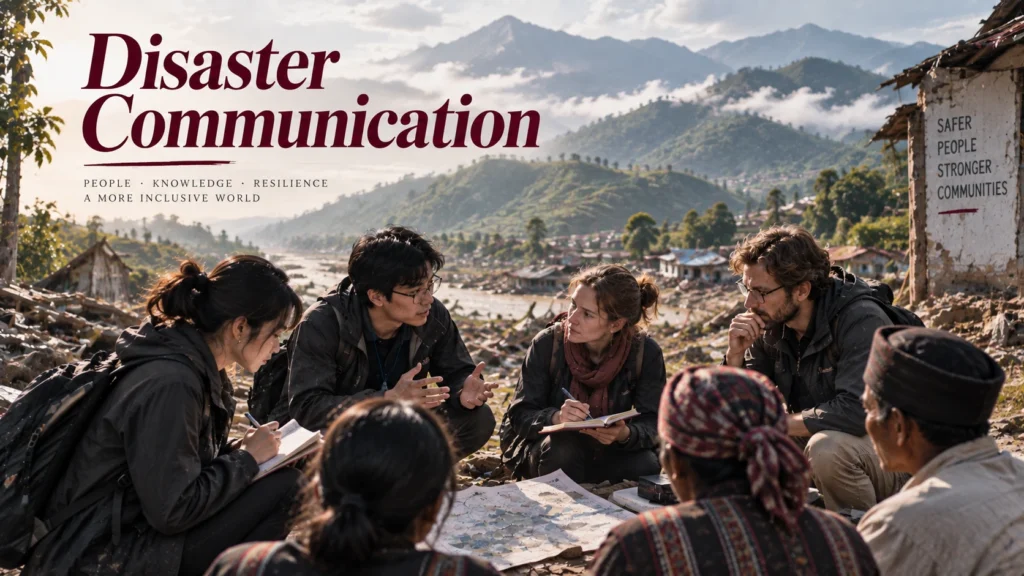
Understanding strategic disaster communication across diverse political, cultural, and institutional contexts
Disasters do not occur in a communication vacuum. The ways in which governments and other organizations communicate before, during, and after disasters are shaped by the political systems, cultural environments, organizational structures, leadership practices, and social conditions in which communication occurs.
Disaster Communication in the Global South is an international comparative research program led by labC – Lab on Crisis, examining how disaster communication is structured, managed, and implemented across diverse Global South contexts. The program is rooted in a central question: How do heterogeneous socio-political and cultural structures shape how disasters are communicated and governed?
The research investigates disaster communication not simply as the transmission of emergency information, but as a strategic and governance process. It examines how governmental communicators define objectives, identify and engage publics, formulate messages, select communication channels, and coordinate with other organizations in responding to disasters. The study also explores how cultural and political environments, organizational characteristics, and leadership practices influence these processes.
A comparative perspective from the Global South
The program brings together comparative research across Vietnam, the Philippines, Indonesia, Mexico, China, and Bangladesh. Its empirical foundation combines official document analysis and in-depth expert interviews, allowing the research to examine both formal communication structures and the experiences and perspectives of actors involved in disaster communication.
The interview component engages different groups of knowledge and practice, including government and political leaders, journalists and communication professionals, and scholars working on disaster and communication research.
The documentary research examines official government records, including legislation, decrees, administrative documents, and official publications. The current research materials focus on typhoon-related disaster communication in China, the Philippines, Vietnam, Indonesia, Bangladesh, and Mexico, with documentary evidence spanning 1990 to 2025.
What does the research examine?
The research framework analyses disaster communication through seven interconnected dimensions:
1. Cultural and Political Environment
How cultural repertoires and political structures influence disaster communication.
2. Organizations and Leadership
How organizational characteristics and leadership practices shape communication responses.
3. Strategic Objectives
How government communicators define and develop disaster communication objectives.
4. Strategic Publics
How different publics—including active publics, passive publics, and key opinion leaders—are understood and addressed.
5. Messages
How communication operates through informing, warning, guidance, and other forms of strategic content.
6. Communication Channels
How official and unofficial channels are mobilized in disaster communication.
7. Regional Cooperation
How Global South states understand and collaborate with one another in disaster communication.
The coding framework allows researchers to examine these dimensions systematically at both the document and individual statement levels, using qualitative analysis with MAXQDA.
From empirical comparison to new knowledge
A central ambition of the program is to look beyond the assumption that disaster communication can be adequately understood through universal models developed primarily in Western contexts.
The Global South is approached not merely as a geographical setting for testing established theories, but as a source of empirical and theoretical knowledge. By comparing societies with different political, cultural, and institutional configurations, the research seeks to identify both common patterns and context-specific forms of disaster communication.
In doing so, the program contributes to labC’s broader research agenda of rethinking risk, crisis, and disaster from Southeast Asia and the Global South.
Research Programme
Disaster Communication in the Global South
Research focus: Strategic Disaster Communication in Heterogeneous Socio-Political Structures
Research methods: Document Analysis · In-depth Expert Interviews · Comparative Research
Countries: Vietnam · Philippines · Indonesia · Mexico · China · Bangladesh
Principal Investigator: Dr. phil. Ngoc-Son Le
labC – Lab on Crisis